A beneficial owner is the natural person or persons who ultimately own or control a company or an association. The concept exists to make it harder to hide money and ownership behind layers of companies, and it is a central part of the fight against money laundering and terrorist financing.
Here we explain who counts as a beneficial owner, how registration with the Swedish Companies Registration Office (Bolagsverket) works, why banks and finance companies have to find out – and what changes when the EU’s new Anti-Money Laundering Regulation (AMLR) applies from 2027.
Who counts as a beneficial owner?
Under current Swedish rules, you are a beneficial owner if you, alone or together with close relatives, control a company. For example, if you:
- own or control more than 25 percent of the votes,
- have the right to appoint or remove more than half of the board members, or
- control the company in another way, for example through an agreement or the articles of association.
Ownership and control can be direct or indirect, for example through another company. Holdings of close relatives are added together. A beneficial owner is always a natural person, never a company.
Which companies must register their beneficial owner?
Most Swedish legal entities must register their beneficial owner with Bolagsverket, for example limited companies, trading partnerships, economic associations, housing cooperatives and foundations. Listed companies are among those exempted. Sole traders are not covered, since the rules apply to legal entities.
If the company cannot identify a beneficial owner, it must still file a notification saying so. When ownership or control changes, the information must be updated. The company, not the beneficial owner, is responsible for the registration.
Why do banks and finance companies need to identify the beneficial owner?
Businesses covered by anti-money laundering rules, such as banks, finance companies, insurance companies and asset managers, must investigate who the beneficial owner of their corporate customers is. It is part of Know Your Customer (KYC).
The Bolagsverket register is an important source, but simply looking it up is not enough. The business must itself take reasonable measures to verify who the beneficial owner is and understand the customer’s ownership and control structure. If the information in the register appears to be wrong, the business must notify Bolagsverket. The check must also be followed up continuously, since ownership can change.
What changes with AMLR in 2027?
From 10 July 2027, the EU’s new Anti-Money Laundering Regulation (AMLR) applies directly throughout the EU. For beneficial ownership this means, among other things, that:
- the threshold becomes 25 percent or more instead of more than 25 percent, so someone who owns exactly 25 percent also counts,
- the rules become more uniform across all EU countries, which helps anyone with customers and owners in several countries, and
- the requirements to understand and document the ownership structure become clearer.
How to make beneficial ownership checks easier
Investigating beneficial ownership manually takes time, especially when ownership runs through several layers. A digital process makes it easier:
- Retrieved and verified information: company details, authorised signatories and beneficial owners are retrieved and validated through information providers such as Roaring and Dun & Bradstreet, so the customer does not have to fill in everything.
- BankID and e-signing: the customer confirms the information digitally.
- Background screening: beneficial owners are checked against PEP and sanctions lists.
- Ongoing monitoring and traceable documentation: changes in ownership structure are picked up so the risk assessment can be updated, and evidence and decisions are stored in a structured way, ready for supervision.
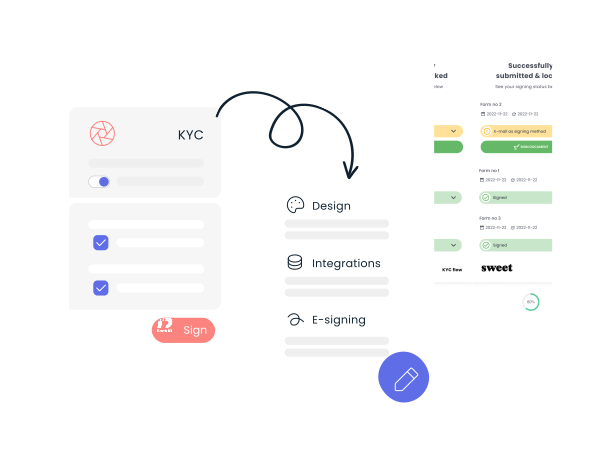
Sweet RegTech Platform brings KYC, AML and follow-up together in one flow for banking, finance and insurance. See how in our use cases, or book a demo.
Frequently asked questions about beneficial owners
Can a company have several beneficial owners?
Yes. If several people each have control, for example by each owning more than 25 percent, they are all beneficial owners.
Is the CEO always the beneficial owner?
No. The CEO and authorised signatories are not automatically beneficial owners. What matters is ownership and control.
What if there is no beneficial owner?
The company must still notify Bolagsverket that a beneficial owner is missing or cannot be determined.
What happens if the company does not register?
Bolagsverket can order the company to register. Missing information can also complicate the relationship with banks and others who are required to know their customers.
Is it enough to check the Bolagsverket register?
No, not for businesses with KYC obligations. The register is a source, but the business must itself verify the information with reasonable measures, and notify Bolagsverket if the register appears to be wrong.
Want to see how it works?
Sweet RegTech Platform helps banking, finance and insurance retrieve, verify and monitor beneficial owners in the same flow as the rest of their KYC. Explore our use cases or book a demo and we will show you how it could work for you.